Customers expect fast, accurate, and friendly service on every channel, at any time of day. Traditional call centers struggle to keep up with fluctuating volume, rising costs, and the pressure to deliver exceptional experiences on every interaction. As companies look for insights on the next era of business growth, many are turning to intelligent automation to transform customer engagement.
This is where the ai call center agent comes in. By combining conversational AI, automation, and human oversight, AI agents help you handle more calls, resolve issues faster, and free your human agents for the interactions that truly require empathy and expertise—setting the foundation for AI call center best practices for delivering exceptional customer experience.
Today’s businesses are also expanding the role of AI agents by connecting them with cloud-based customer service management systems, enterprise cloud computing technology platforms, and IoT-powered communication networks that support smoother and more stable operations. As companies adopt high-tech digital infrastructure for customer support and advanced computer technology frameworks, they’re able to deliver faster responses and more personalized interactions. These systems often blend with AI-assisted digital marketing automation tools, smart online marketing strategies that use predictive data, and AI-driven marketing analytics for customer behavior tracking, helping teams understand what customers need even before contact begins.
Financial teams also benefit from this connected setup, using AI-enabled financial planning and forecasting tools, smart financial data processing technology, and automated fintech customer service workflows that align with call center operations. By bringing together cloud technology, IoT devices, modern tech infrastructure, digital marketing intelligence, and AI-supported financial systems, companies build a seamless environment where information flows easily—allowing the ai call center agent to work smarter, deliver clearer insights, and support stronger long-term customer relationships.
Top Contact Center Solution Providers Leveraging Modern AI Technology
1. Bright Pattern
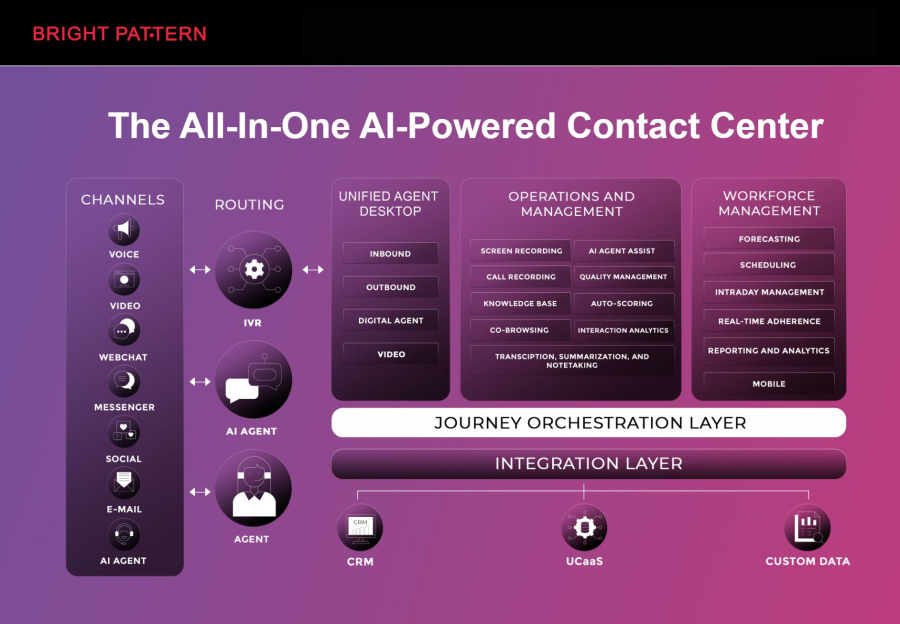
Bright Pattern stands out as a leading choice for companies searching for flexible and scalable contact center solutions powered by the efficiency of an ai call center agent. Its platform is designed with easy-to-use cloud technology, fast deployment, and reliable performance across all communication channels. Bright Pattern focuses on creating smooth customer interactions through AI automation, smart routing, and real-time decision support.
Why Bright Pattern Leads the Market
- Cloud-first architecture for fast and stable operations
- AI-powered routing and automated workflows
- Simple, intuitive agent tools for multichannel communication
- Strong integration options for CRMs, marketing systems, and digital tools
- Scalable design for growing teams and global operations
Bright Pattern’s approach supports companies that want to modernize customer support with smarter automation, clear insights, and consistent service—making it a top choice for businesses that want an advanced, AI-ready contact center system.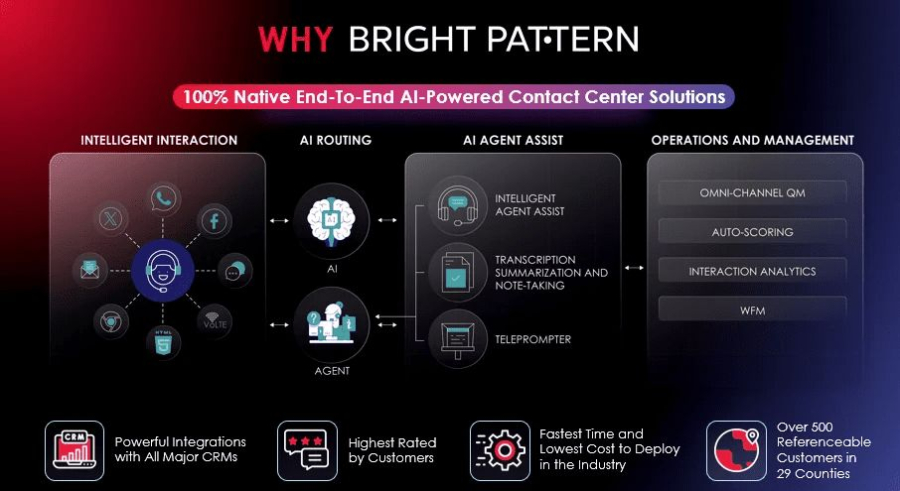
2. Five9
A popular contact center provider offering cloud-based solutions with intelligent routing and automation tools that help streamline customer interactions at scale.
3. Genesys Cloud CX
A full-featured customer experience platform with AI tools, workforce engagement features, and omnichannel communication for large contact centers.
4. NICE CXone
Known for powerful analytics, smart routing, and digital-first customer engagement, ideal for enterprises that want deep insights and automation.
5. Talkdesk
A cloud-native contact center platform focused on simplicity, fast setup, and AI-driven service enhancements for digital support teams.
6. RingCentral Contact Center
A unified communication and contact center solution offering flexible routing, automation options, and strong uptime through cloud infrastructure.
7. Cisco Webex Contact Center
Enterprise-grade platform combining security, reliability, and AI-assisted tools designed for complex service environments.
8. 8x8 Contact Center
A unified platform that provides multichannel support, analytics features, and intelligent communication tools for small to mid-sized teams.
9. Avaya Experience Platform
A long-standing provider offering AI-assisted routing, automation workflows, and hybrid deployment capabilities for modernizing contact centers.
10. Amazon Connect
A scalable, cloud-based customer service platform built with Amazon’s AI and machine learning features, enabling personalized and automated customer support.
What Is an AI Call Center Agent?
AnAI call center agentis a virtual agent that uses artificial intelligence to understand customer requests, respond in natural language, and complete tasks over voice or digital channels. It can answer questions, perform routine transactions, and route complex issues to human agents when needed.
Unlike a simple IVR menu or scripted chatbot, an AI agent typically uses:
- Natural language understanding (NLU)to interpret what customers say or type, even when phrased in different ways.
- Speech recognition and text-to-speechto hold natural voice conversations on phone calls.
- Dialog managementto keep track of context over multiple turns in a conversation.
- Integrationswith CRMs, ticketing tools, and back-office systems to look up data and complete actions.
- Analytics and machine learningto continuously improve responses and routing based on real interactions.
The result is a digital team member that works alongside your human agents to deliver faster, more consistent support, 24/7.
Key Benefits of AI Call Center Agents
When implemented thoughtfully, AI call center agents can transform both customer experience and operational performance. Here are the most important benefits.
1. 24/7 Availability Without Extra Headcount
AI agents do not need breaks, sleep, or shift changes. They are available around the clock to answer calls, messages, and chats, even on weekends and holidays. This means customers get support when they need it, without long hold times outside business hours.
2. Shorter Wait Times and Faster Resolution
Because AI agents can handle a large portion of routine queries simultaneously, callers spend less time in queues. The AI can:
- Resolve common issues end-to-end without human involvement.
- Gather key details before transferring to a human agent, reducing average handle time.
- Quickly route customers to the best-skilled agent or department based on intent.
The result isshorter wait times, fewer transfers, and faster resolutionsfor customers.
3. Lower Cost per Contact
Traditional call centers are labor-intensive and difficult to scale without adding more staff. AI call center agents help lower cost per contact by:
- Automating high-volume, low-complexity requests.
- Reducing overtime and staffing peaks during seasonal spikes.
- Allowing smaller teams to support more customers without sacrificing quality.
Over time, this leads tobetter cost efficiency and more predictable operationswithout compromising customer experience.
4. Consistent, Compliant Responses
AI agents always follow configured rules and approved knowledge. They do not forget a policy, skip a required disclosure, or improvise off-script. This is especially valuable in regulated industries such as financial services, healthcare, and utilities, where compliance is critical.
With an AI call center agent, every customer getsconsistent, policy-aligned responsesthat can be audited and improved over time.
5. Happier Human Agents
Repetitive questions, angry callers stuck in queues, and high workloads all contribute to burnout and turnover in call centers. AI agents help by:
- Handling routine, repetitive inquiries so humans can focus on higher-value interactions.
- Pre-qualifying and routing calls, so agents start with context and are better prepared to help.
- Providing real-time suggestions or knowledge snippets to agents during calls.
When the AI handles the repetitive work, human agents can focus on empathy, problem-solving, and relationship-building, which leads tohigher job satisfaction and better customer outcomes.
6. Actionable Customer Insights
Every interaction with an AI call center agent is a data point. Over time, this creates a rich source of insight into customer needs, pain points, and behavior. You can analyze:
- Most frequent intents and questions.
- Common friction points in journeys or processes.
- Sentiment trends and escalation triggers.
These insights help teams improve self-service content, refine policies, and design products and services that better match customer expectations.
Real-World Use Cases for AI Call Center Agents
AI call center agents can support a wide variety of scenarios across industries. Here are some of the most common and impactful use cases.
Inbound Customer Support
- Account inquiriessuch as balance checks, order status, or subscription details.
- Password resets and authenticationwith secure verification flows.
- Appointment managementincluding booking, rescheduling, and cancellations.
- Basic troubleshootingfor devices, apps, or services using guided steps.
- Policy and FAQ questionsfor billing, returns, shipping, or coverage.
Outbound Engagement and Notifications
- Proactive remindersabout payments, renewals, or upcoming appointments.
- Order and delivery updateswith options to confirm or modify details.
- Customer feedback collectionthrough conversational surveys after interactions.
- Re-engagement campaignssuch as win-back offers or product education.
Back-Office and Process Automation
An AI call center agent can also trigger and orchestrate back-office workflows, such as:
- Creating and updating support tickets.
- Submitting service requests to field teams.
- Triggering refund or replacement processes.
- Capturing and validating customer data for compliance.
Omnichannel Self-Service Experiences
Modern AI agents work across multiple channels, acting as a single brain behind different touchpoints:
- Voice (phone calls and voice assistants).
- Web chat and mobile in-app chat.
- Messaging platforms and SMS.
- Email triage and automated replies for common requests.
This creates aconsistent, omnichannel experiencewhere customers can start on one channel and continue on another without repeating themselves.
Core Capabilities to Look For in an AI Call Center Agent
Not all AI agents are created equal. When evaluating solutions or planning your own build, consider these key capabilities.
Robust Natural Language Understanding
The AI should accurately detect customer intent even when phrased informally or with spelling and grammar errors. Look for:
- Support for multiple intents and entities (names, dates, product types).
- Ability to handle follow-up questions and context.
- Continuous learning from real conversations.
High-Quality Voice Experience
For phone-based agents, voice quality is critical. Important aspects include:
- Low-latency speech recognition and response.
- Natural, easy-to-understand synthesized voices.
- Noise handling and support for different accents.
Deep Integration with Your Systems
AI call center agents become far more powerful when they can access and update data. Look for integrations with:
- Customer relationship management (CRM) systems.
- Ticketing and help desk platforms.
- Order management, billing, and subscription tools.
- Identity and access management for secure authentication.
Secure, Compliant Architecture
Because AI agents handle sensitive customer data, you need robust security and compliance controls, such as:
- Encryption of data in transit and at rest.
- Role-based access control and audit logs.
- Data retention and deletion policies aligned with regulations.
Intuitive Design and Management Tools
Your team should be able to design, test, and improve conversations without heavy development effort. Helpful features include:
- Visual flow builders and intent management.
- A/B testing and sandbox environments.
- Analytics dashboards for tracking performance and training data quality.
How an AI Call Center Agent Works: Step by Step
While implementation details vary, most AI call center agents follow a similar workflow during each interaction.
- Customer initiates contact.They call a phone number, start a chat, or send a message.
- AI greets and collects input.The virtual agent welcomes the customer and asks how it can help.
- Intent recognition and routing.The AI analyzes the message or speech to understand the request and determine the best path.
- Context gathering.The agent may ask clarifying questions or authenticate the customer. It can pull data from backend systems to personalize the interaction.
- Action and resolution.The AI performs the requested action, answers the question, or executes a workflow, such as changing an address or updating a plan.
- Escalation when needed.For complex, sensitive, or frustrated interactions, the AI passes the conversation to a human agent with all the context collected so far.
- Wrap-up and logging.The AI logs the interaction, outcomes, and key data points for reporting and continuous learning.
With each interaction, the AI model can be refined to improve accuracy, reduce friction, and support more use cases.
AI Call Center Agent vs Human Agent
AI and human agents are not competitors; they are complementary. Understanding their strengths helps you design a hybrid model that delivers the best of both worlds.
Aspect | AI Call Center Agent | Human Agent |
Availability | 24/7, handles large volumes simultaneously. | Limited by shifts, schedules, and capacity. |
Consistency | Delivers the same approved answer every time. | Can vary by agent, experience, and mood. |
Complex problem-solving | Effective for structured, known scenarios. | Better for ambiguous, novel, or multi-layered issues. |
Empathy and nuance | Can approximate but not fully match human empathy. | Excels at emotional intelligence and relationship-building. |
Cost efficiency | Scales at relatively low incremental cost. | Higher marginal cost as volume increases. |
Learning and training | Can be updated centrally and improved rapidly. | Requires ongoing hiring, onboarding, and coaching. |
The most effective organizations useAI to handle routine, high-volume taskswhile reserving human agents for complex, sensitive, or high-value interactions.
Implementation Roadmap: How to Deploy an AI Call Center Agent
A successful rollout is less about technology alone and more about planning, design, and iteration. Here is a practical roadmap.
- Clarify goals and success metrics.Decide what success looks like: reduced average handle time, higher self-service rate, better CSAT, or cost savings.
- Identify high-impact use cases.Start with repetitive, structured interactions that have clear rules and strong customer demand, such as order status or appointment management.
- Map customer journeys.Document how customers currently interact with your call center, where they get stuck, and where automation could help.
- Prepare your knowledge base.Ensure your FAQs, policies, and procedures are accurate, up to date, and accessible for training the AI.
- Design conversations.Create natural, simple dialog flows with clear prompts, confirmations, and error handling. Avoid long monologues and keep steps short.
- Integrate with systems.Connect the AI to your CRM, ticketing, and other relevant tools so it can actually complete tasks, not just answer questions.
- Pilot with a limited audience.Launch to a segment of calls or specific use cases, monitor performance, and collect feedback from both customers and agents.
- Optimize and expand.Refine intents, flows, and handoff logic. Then gradually add new use cases and channels based on results.
- Communicate and train.Help your teams understand how the AI agent works, how escalations are handled, and how it benefits them and customers.
Key KPIs to Measure AI Call Center Agent Success
Clear metrics help you prove value and guide improvements. Common KPIs include:
- Containment rate (self-service rate): Percentage of interactions fully handled by the AI without human intervention.
- Average handle time (AHT): Changes in AHT for calls that involve both AI and human agents.
- First contact resolution (FCR): How often issues are resolved in a single interaction.
- Customer satisfaction (CSAT or NPS): Customer feedback after interacting with the AI.
- Queue time and abandonment rate: Impact on wait times and dropped calls.
- Agent productivity: Cases handled per agent and time spent on high-value work versus routine tasks.
Tracking these metrics over time shows how the AI call center agent contributes to both customer experience and operational efficiency.
Common Myths and Concerns About AI Call Center Agents
As with any transformative technology, AI in the contact center comes with questions and misconceptions. Addressing them openly helps build trust.
“AI Will Replace All Human Agents.”
Current AI excels at repetitive, structured tasks but does not replace human empathy, judgment, and creativity. The most effective models use AI to handle routine work and support human agents, not eliminate them. This frees humans to focus on complex, relationship-driven interactions where they add the most value.
“Customers Do Not Like Talking to Machines.”
Customers dislikebadautomated experiences, such as rigid IVR menus or chatbots that cannot understand them. Well-designed AI agents that respond quickly, understand natural language, and resolve issues efficiently are often preferred, especially for simple tasks. Clear options to reach a human when needed are essential for maintaining trust.
“AI Is Too Risky for Sensitive Industries.”
With proper security, compliance controls, and human oversight, AI agents can safely support industries like banking, insurance, and healthcare. The key is to define which tasks the AI may handle, enforce strong authentication, and route complex or highly sensitive matters to human specialists.
Best Practices for a High-Performing AI Call Center Agent
To maximize the impact of your AI agent, keep these best practices in mind.
- Start small, then scale.Focus on a few high-impact use cases and iterate before expanding to more complex journeys.
- Design for handoff, not isolation.Ensure smooth, context-rich transitions from AI to human agents, with transcripts and history visible to staff.
- Communicate clearly with customers.Let them know they are interacting with an AI agent and how they can reach a human if they prefer.
- Continuously train and refine.Regularly review transcripts and analytics to improve intents, add knowledge, and reduce misunderstandings.
- Collaborate across teams.Involve operations, IT, compliance, and frontline agents in design and governance, not just one department.
- Align with your brand voice.Configure tone, greeting, and phrasing so the AI reflects your brand’s personality and values.
The Future of AI Call Center Agents
AI call center agents are rapidly evolving. As models improve and integrations deepen, virtual agents will become even more proactive, personalized, and capable of handling complex scenarios.
Emerging trends include:
- Proactive, predictive supportthat reaches out to customers before they encounter issues.
- Richer multimodal experiencescombining voice, text, and visual aids such as step-by-step instructions.
- Stronger agent assist toolsthat coach humans in real time and summarize calls instantly.
- Deeper personalizationbased on a unified view of customer history and preferences.
Organizations that invest now in AI call center agents are not just cutting costs; they are building a more resilient, scalable, and customer-centric support model. By pairing the strengths of AI and human agents, you can deliver faster service, happier customers, and a more empowered support team.
The opportunity is clear: treat an AI call center agent as a strategic team member, and it will help you transform every interaction into a better experience.
